Sign in
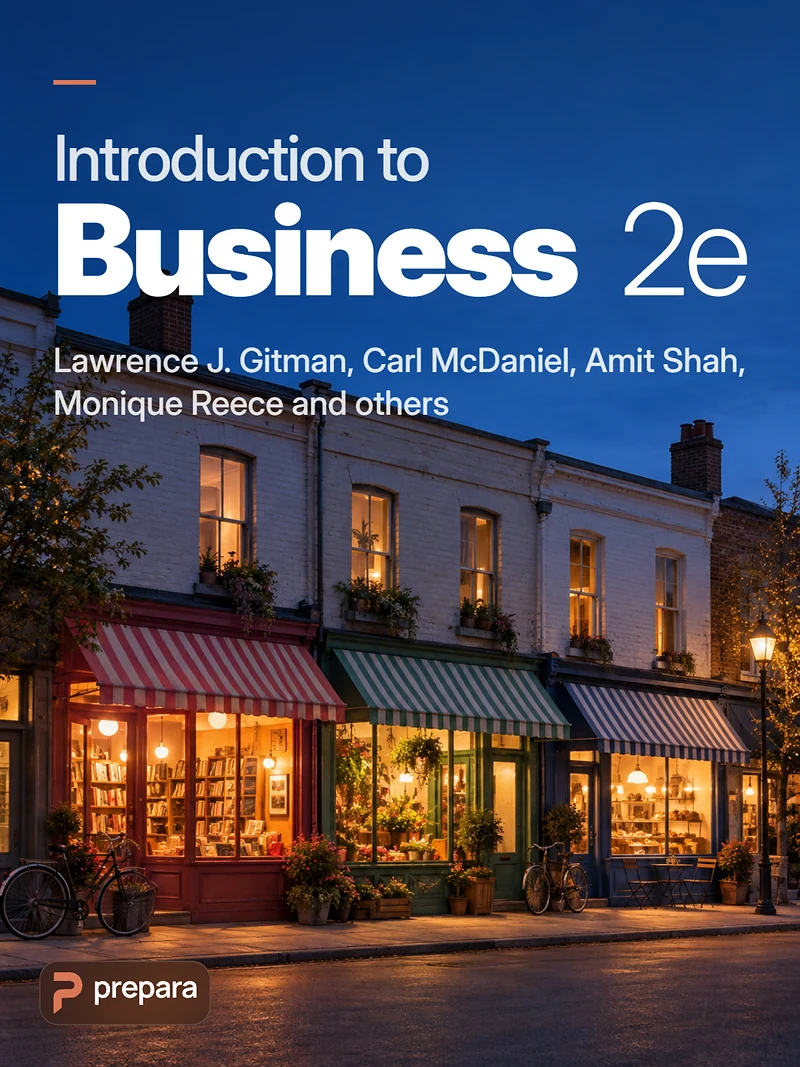
Introduction to Business 2e cover

Introduction to Business 2e

Published by OpenStax under the CC BY-NC-SA 4.0 license

Lawrence J. GitmanSan Diego State University - EmeritusCarl McDanielUniversity of Texas, ArlingtonAmit ShahFrostburg State Universityand 4 more authors

Credit and license

Introduction to Business 2e by Lawrence J. Gitman, Carl McDaniel, Amit Shah, Monique Reece, Linda Koffel, Bethann Talsma and James C. Hyatt. Published by OpenStax (2026) under the Creative Commons Attribution-NonCommercial-ShareAlike License 4.0. Read it free at openstax.org.

Changes: none. Prepara shows the text as OpenStax published it and adds its course tools around it.

The cover on this page is Prepara's own. The OpenStax name, logo and covers are not part of the license, and OpenStax does not endorse Prepara.

What is inside this book

Features in every Prepara book

Besides the reading, every chapter has short lesson films, a tutor students can ask, and questions that are graded for you.

Students watch short films on the chapter and answer graded questions about them; a wrong answer opens a short explainer and a chance to earn back part of the credit.

Lessons / Principles of MarketingWhat Is Marketing?
Section 4 of 6The four Ps, and the decisions hiding inside them
0:27 / 2:01
PreparaAsk me if the video mentions anything you'd like clarified
Question 1 of 3

The section says the single word Product was hiding three separate jobs. What are they?

Ask PreparaRead about itRewind0 of 3 selected

Based on what you missed here, I recommend you watch a short explainer on this.

Question 1

The section says the single word Product was hiding three separate jobs. What are they?

The product, the price charged, and the place it is sold. Price and Place are already their own words on the list, so they were never hiding inside Product.

The correct answer stays hidden until you try the similar question below.

What you need to do next

Finish one of these four activities to move on.

Recommended for what you missed
Or pick a different one:Read the passageTry the interactiveSee the figure

Then earn the credit back

Try a similar question

This unlocks as soon as you finish an activity above. It is worth half the credit for this question.

Reviewed 0 of 1 incorrect question. The lesson continues after you review it.
Watch the explainerPrinciples of Marketing, Chapter 2
0:00 / 0:27
Similar questionWorth half the credit

A team lists its marketing decisions and writes Product as a single line. Which three decisions does that one line quietly cover?

You answered the similar question right and earned back half the credit.

Students can ask the tutor about anything in the chapter; it answers from the book, names the section it used, and can quiz them.

Principles of Marketing · Chapter 3

The Marketing Environment

Netflix changed its business three times as conditions changed, with each change coming a year or two before its competitors responded. In 1998, Netflix’s founders began mailing DVDs because home internet connections were too slow for streaming. By 2007, internet connections had become fast enough for streaming, so Netflix moved to streaming while Blockbuster, the country’s largest video-rental chain, continued to rely on its 9,000 stores.

Blockbuster filed for bankruptcy protection in September 2010 with a billion dollars of debt. By 2018, the stock market valued Netflix above every traditional studio competing to reach viewers on the same screens. A brand that keeps studying changes in its environment tends to outperform a brand that continues to rely on the previous year’s view of those conditions.

The marketing environment keeps changing. This chapter explains the tools a marketing team can use to analyze those changes.

HighlightNoteAsk AI
Ask PreparaTutor
Ask about this chapter…
Answers come from the book. Your instructor can review these conversations.

It won’t give students the answer to a graded question.How the tutor works →

Scores on the questions in each lesson go into the Prepara gradebook and then to your LMS gradebook.

Chapter 2 lessonMaya Chen
  • ✓Question 1
  • ✓Question 2
  • ✓Question 3
0 of 3 answered
Prepara gradebookMKTG 3323
StudentCh 1 lesson3 ptsCh 2 lesson3 ptsOverall
ABAva Brooks32.591%
DPDevon Park2384%
ESEmma Silva3396%
JNJack Nguyen2.5263%
MCMaya Chen3–78%
Updated as each student answers
LMS gradebookMKTG 3323
StudentCh 2 lessonfrom Prepara
ABAva Brooks2.5
DPDevon Park3
ESEmma Silva3
JNJack Nguyen2
MCMaya Chen–
Waiting for new gradesSent from Prepara

Choose which of the book’s chapters your section uses and in what order, and Prepara numbers them for your students in that order.

All book chaptersIntroduction to Business 2e · 17 chapters
Your sectionMKTG 3323 · 0 chapters

Drop chapters here

19 chapters in the book12 in your course, numbered 1 to 12
3 Segmentation, Targeting, PositioningSettingsContentsNotesAsk

Segmentation, Targeting, Positioning

Learning objectives

By the end of this chapter, you will be able to:

  • Take a market through the three steps in order: cut it into segments, pick the segment you will serve, and decide how you want the buyer to remember the brand.
  • Cut a market into segments whose buyers share the same needs inside a group and differ across groups, using descriptors you can actually act on.
3.1 Why STP exists at all

Segmentation, targeting, and positioning are necessary because buyers differ from one another. Two people can reach for the same forty-ounce insulated cup for completely different reasons. One buyer may need to drink that much water on a worksite, while the other may choose the cup because its color matches the inside of the car.

A seller who ignores these differences designs an offer for an average buyer who does not exist. Real buyers are spread out around that average rather than clustered at it. Customer heterogeneity is the formal name for this variation.

*Examples show the Principles of Marketing book.

From this book

The reading and the interactives

What this book itself contains: its chapters as students read them and the interactives inside them.

*Examples show the Principles of Marketing book.

The reading

How chapter 3, The Marketing Environment, opens for students: the text, its figure, and an interactive they can try.

Interactive widgets in every chapter

Every chapter has interactives students can try, built on the chapter's own examples and numbers. Here are four of them; pick one and try it.

Table of contents

17 chapters

17 chapters, 134 sections
01
Understanding Economic Systems and Business8 sections
02
Making Ethical Decisions and Managing a Socially Responsible Business5 sections
03
Competing in the Global Marketplace9 sections
04
Forms of Business Ownership7 sections
05
Entrepreneurship: Starting and Managing Your Own Business8 sections
06
Management and Leadership in Today's Organizations8 sections
07
Designing Organizational Structures8 sections
08
Managing Human Resources and Labor Relations10 sections
09
Motivating Employees8 sections
10
Achieving World-Class Operations Management8 sections
11
Creating Products and Pricing Strategies to Meet Customers' Needs10 sections
12
Distributing and Promoting Products and Services11 sections
13
Using Technology to Manage Information6 sections
14
Using Financial Information and Accounting8 sections
15
Understanding Money and Financial Institutions6 sections
16
Understanding Financial Management and Securities Markets8 sections
17
Your Career in Business6 sections

Your course does not have to use every chapter. You choose the chapters to assign, and the book keeps prerequisite topics in order.

Authors

The 7 authors

Lawrence J. GitmanSan Diego State University - Emeritus

Lawrence J. Gitman is a prolific author, with over fifty published articles and a number of best-selling college textbooks (some with coauthors).

Source: openstax.org
Carl McDanielUniversity of Texas, Arlington

Carl McDaniel’s career has spanned more than 40 years, during which he was the recipient of several awards for outstanding teaching. He was the chair of the University of Texas at Arlington marketing department for 32 year, and now teaches executive MBA courses locally and in China.

Source: openstax.org
Amit ShahFrostburg State University

Amit Shah is professor of management and director of the Center for Community Partnerships at Frostburg State University (FSU) in Maryland. He has over 20 years of experience in industry and academia.

Source: openstax.org
Monique ReeceSenior contributing author

Monique Reece is the founder and CEO of MarketSmarter, a marketing consulting and training firm that helps companies improve strategy and implement real-time business planning processes to develop a culture of execution. She has more than 20 years of marketing and executive management experience working with both Fortune 100 companies and fast-growing entrepreneurial businesses.

Source: openstax.org
Linda KoffelHouston Community College

Linda Koffel has been teaching at Houston Community College. She is a winner of the Consortium of Community Colleges for Innovation, a prestigious NISOD award for teaching.

Source: openstax.org
Bethann TalsmaDavenport University and Grand Rapids Community College

Bethann Talsma is the founder of Platinum Properties, an income property business that provides housing in Grand Rapids, Michigan. She has more than 15 years of experience managing all operations including property procurement, tenant interaction, project management, and administration.

Source: openstax.org
James C. HyattUniversity of The Cumberlands

Professor Hyatt serves the University of the Cumberlands teaching graduate courses for the School of Computer and Information Sciences, Executive Programs. He has served as an Assistant Professor at Fort Hays State University and Ashford University, where he taught Business, Technology and Analytics Courses.

Source: openstax.org

Talk with Prepara.

Ask about adopting a course, building one, or bringing your own book. Our team replies to every request.

Contact us